Gross Wages vs. Net Wages — What’s the Difference?
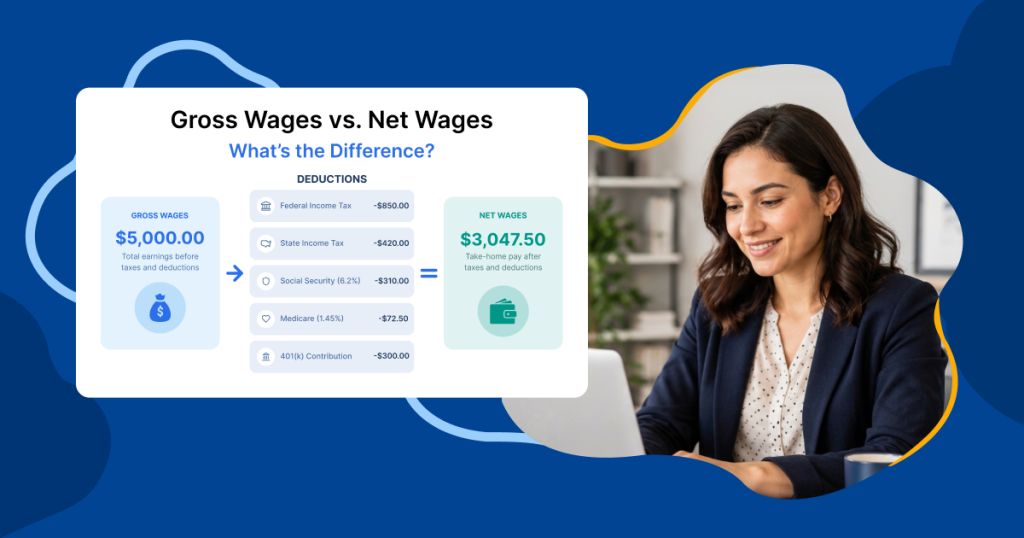
Two terms appear on virtually every paystub: gross wages and net wages.
Understanding what each means — and how to calculate them — is foundational knowledge for both employers running payroll and employees managing their finances.
What are Gross Wages?
Gross wages are the total amount an employee earns before any taxes or deductions are subtracted.
For most employees, gross wages consist primarily of base pay — whether that’s a salary, hourly rate, or tips — plus any additional compensation such as overtime, bonuses, or commissions.
Factors that can affect an employee’s gross wages each pay period include:
- Their base wage rate, either hourly or salaried
- Hours worked, including any overtime
- Additional pay types such as bonuses, commissions, or piece-rate pay
- Pay frequency — weekly, bi-weekly, semi-monthly, or monthly
Overtime is typically paid at 1.5x the regular rate under the Fair Labor Standards Act for non-exempt employees.
Calculating Gross Pay
The calculation method depends on whether an employee is hourly or salaried.
Hourly Employees
For hourly employees, multiply the hourly rate by the number of hours worked in the pay period. Overtime hours, generally over 40 hours per week for federal FLSA purposes, are multiplied by 1.5x the regular rate.
Salaried Employees
For salaried employees, divide the annual salary by the number of pay periods in the year.
Standard pay period counts for 2026 include:
- Weekly: 52 pay periods
- Bi-weekly: 26 pay periods
- Semi-monthly: 24 pay periods
- Monthly: 12 pay periods
Note: In 2026, bi-weekly payroll may produce 27 pay periods for some employers, depending on the calendar start date — an important consideration for salary calculations.
What are Net Wages?
Net wages, often called “take-home pay,” are what the employee actually receives after all deductions and withholdings are applied. The gap between gross and net pay can be substantial, which is why reviewing pay stubs carefully matters.
Common Deductions That Reduce Gross Pay
Several taxes and deductions reduce gross pay to net pay.
Federal Income Tax Withholding
Federal income tax withholding is calculated based on the employee’s gross wages, pay frequency, and the elections on their Form W-4.
Tax rates in 2026 follow the IRS progressive bracket system, with rates ranging from 10% to 37% depending on taxable income and filing status.
State and Local Income Tax Withholding
State and local income tax withholding varies by state. Nine states have no state income tax on earned wages as of 2026:
- Alaska
- Florida
- Nevada
- New Hampshire
- South Dakota
- Tennessee
- Texas
- Washington
- Wyoming
All other states impose varying rates and may have county or city taxes as well.
FICA Taxes: Social Security and Medicare
FICA taxes are split equally between employer and employee.
For 2026:
- Social Security: 6.2% on wages up to the annual wage base
- Medicare: 1.45% on all wages
- Additional Medicare Tax: 0.9% on wages above $200,000 for single filers and $250,000 for married filing jointly
The Additional Medicare Tax is paid entirely by the employee.
The combined employee FICA contribution is 7.65% up to the Social Security wage base.
Employees may authorize deductions for:
- Health insurance premiums
- 401(k) contributions
- FSA or HSA contributions
- Commuter benefits
These are taken before tax calculations, reducing both taxable income and FICA taxes in many cases.
Wage Garnishments
Court-ordered deductions such as child support, alimony, student loan repayments, or tax levies are applied after all other deductions.
Employers must comply with garnishment orders and federal limits on the amount that can be garnished per pay period.
How to Calculate Net Pay
Gross Pay − Pre-Tax Deductions − Federal Income Tax − State/Local Taxes − FICA Taxes − Post-Tax Deductions = Net Pay
123PayStubs Handles It Automatically
123PayStubs calculates both gross and net wages automatically based on the information you input.
Federal withholding, state taxes, FICA, FUTA, SUTA, and any additional deductions or earnings are all handled for you — giving you accurate, professional paystubs without manual calculation.Visit 123PayStubs.com to get started.
Leave a Comment